|
|
|

 | Simo Jelača | |
| |
detail from: KRK Art dizajn
RECOGNITION OF ART
SIMO JELAČA, Ph.D.
GOTHIC
The Middle Ages in Europe, from the 12th to the 15th centuries, were a period of significant economic and social change. Monarchies enabled the development of a new social order in which craftsmen, merchants, and bankers—living in increasingly powerful cities—prospered. The clergy also expanded its influence. The Gothic style came to dominate the arts.Although the Goths were a barbarian people originating from Scandinavia, their influence is not directly reflected in Gothic art. In the 1st century AD, they migrated southward and settled along the left bank of the Danube.In architecture, the earliest examples of the Gothic style appeared north of Paris, in a region rich in high-quality building stone. Between 1140 and 1144, an unknown architect renovated the Abbey of Saint-Denis, and he is considered the originator of the Gothic style. From that point onward, the construction of Gothic churches spread rapidly. The French architect William of Sens began the construction of Canterbury Cathedral in 1174, and similar projects soon followed across Europe. Developments in sculpture, painting, goldsmithing, and tapestry accompanied this architectural expansion, and Gothic art became an international phenomenon.
Architecture
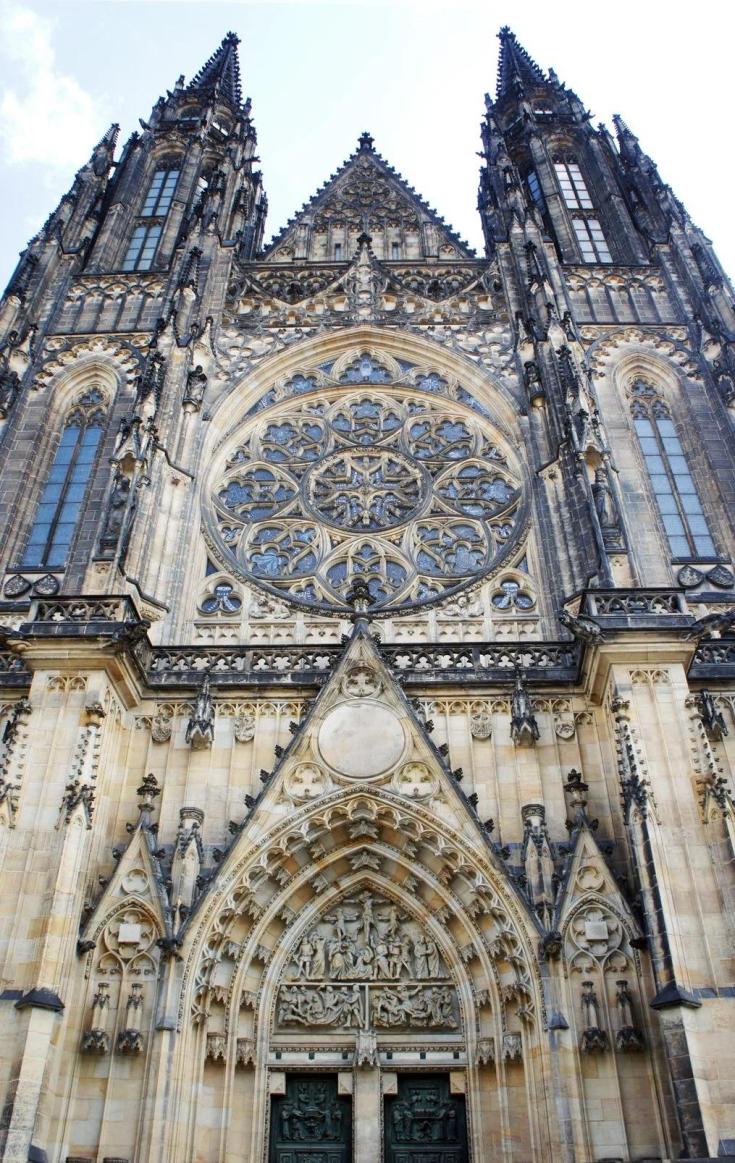
Gothic society flourished: artisans and merchants enjoyed greater freedom in cities, while the clergy remained highly influential. Gothic cathedrals were designed to be visible from great distances. Their structural systems emphasized verticality, with pointed arches and ribbed vaults distributing weight efficiently.A system of intersecting arches—one above another—helped absorb lateral pressure. Rose windows, often composed of concentric circular designs, became a defining feature. Through these innovations, weight was transferred through arches and columns down to the foundations. So-called “interlaced arches,” influenced by Eastern traditions, also appeared.According to ecclesiastical norms, the interior of a cathedral was typically laid out in the form of a Latin cross along the east–west axis, with the altar positioned in the eastern end, facing Jerusalem. The space was divided into the central nave and side aisles, creating a powerful sense of vertical elevation. Each transverse arch supported the vault above.Imposing façades became a hallmark of Gothic cathedrals. The interior of Cologne Cathedral, for example, creates a striking visual effect due to the proportion between the width of the nave and its height (approximately 1:3.8), among the most extreme in the world.
Unlike earlier construction methods, the Gothic system—using ribbed vaults and flying buttresses—allowed walls to be relieved of their load-bearing function. This made it possible to introduce large windows filled with stained glass, increasing the amount of light within the interior. Slender columns and pointed arches became characteristic features of Gothic architecture.Statues decorating the exteriors of cathedrals adhered to principles of verticality, while portals were richly adorned with sculptural programs, often with figures placed in recessed niches. Gothic architecture spread throughout Europe, with regional variations. By the late Middle Ages, stone had almost entirely replaced wood in church construction.
Sculpture
Gothic sculpture was primarily created to decorate churches and took the form of monumental figures. These sculptures are characterized by verticality and a certain formal rigidity, although later works display increased naturalism and movement.Early Gothic figures are elongated, often attached to architectural elements such as columns, with arms close to the body and stylized drapery. The head is typically small in proportion to the body. Subjects frequently include figures from the Old Testament, as well as representations of Christ and the Virgin and Child.Female figures, especially depictions of the Virgin Mary, are notably elongated and graceful. Many important works were produced by sculptors from regions such as present-day France, Germany, and Bohemia. Gothic sculptures were often originally painted in vivid colors and gilded, although much of this polychromy has not survived.
Applied Arts
Applied arts in the Gothic period include stained glass, goldsmithing, and illuminated manuscripts. While architecture, sculpture, and painting were considered the principal arts, applied arts achieved remarkable levels of refinement, especially during the later Middle Ages.Wealthy patrons commissioned luxurious objects such as goldwork, tapestries, and finely decorated manuscripts for private use. Stained glass, however, remained closely associated with ecclesiastical architecture, adorning the windows of churches and cathedrals.One of the most famous achievements of Gothic goldsmithing is the Shrine of the Three Kings, attributed to Nicholas of Verdun. Constructed in the form of a basilica with three naves, it features an oak core covered with richly decorated silver reliefs, evoking the structure of a cathedral.Illuminated manuscripts reached extraordinary levels of originality and beauty. By the mid-13th century, Paris had become a major center of production. Tapestries were also widely used, often depicting floral motifs, scenes of courtly life, and fashionable figures, and were used to decorate interior walls.
Painting
Painting in the Gothic period was generally considered less significant than architecture and sculpture, although it played an important decorative role. It was often used in castles and noble residences as a more affordable alternative to tapestries.Common themes included courtly life, chivalric tales, and fantastic narratives, as well as scenes from everyday rural life. Female figures were typically depicted as elegant and refined, while knights appeared in shining armor. Religious imagery—especially representations of Christ—was present in virtually all churches.Distinct regional schools of Gothic painting developed across Europe, each contributing to the diversity of the style.
|