|
|
|

 | Željka Avrić | |
| |
detail from: KRK Art dizajn
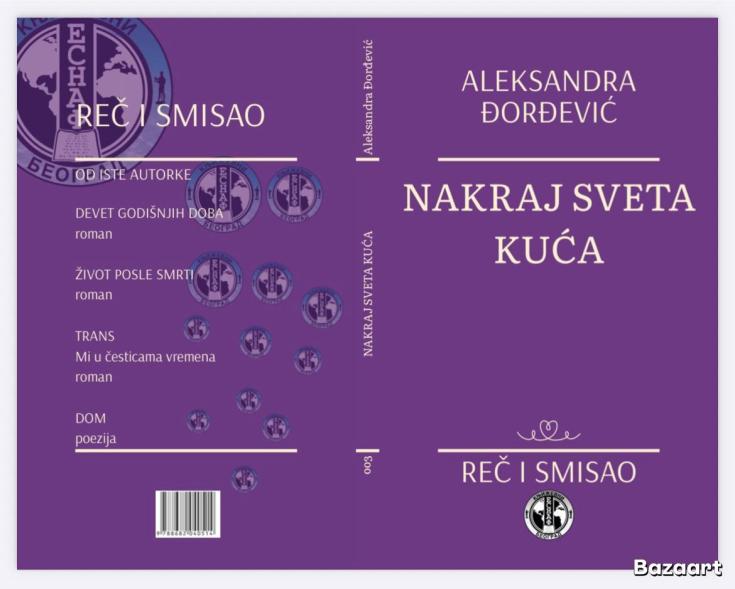
A House That Is a Home(Aleksandra Đorđević: At the Edge of the World, a House “Književni esnaf” – series Word and Meaning, Belgrade, 2025)
By Željka Avrić After three published novels and a book of poetry, the writer, essayist, and translator Aleksandra Đorđević returns to her readers with a collection of short prose, At the Edge of the World, a House. Fourteen short stories, fourteen different thematic and motivational choices, settings and temporal frameworks, atmospheres, characters, and their interrelations—are told through diverse narrative techniques and forms: from confession to collage-like alternations between present and past, to a story composed entirely of exchanged emails. What unites them all are two words: world and house.The wide world to which Đorđević’s imagined and real protagonists depart—or from which they return—and the house, as the central axis around which individual lives and the lives of those closest to them are wound and entwined like a ball of yarn: their families, partners, relatives, children, and with them their destinies, emotions, lived experiences, falls and ascents, silences and screams, wounds and muteness, departures and returns, passions, recklessness, longings, moral and emotional frustrations, but also understanding and forgiveness. Only one thing is absent forgetting.Aleksandra Đorđević’s narrative world is inhabited by ordinary people whose everyday lives feel familiar (which makes them typical characters) yet marked by traits that render them unique. This world is also made up of houses that remember the days and nights of their inhabitants, the members of their families, spouses, descendants, and the relationships among them. Some are deeply rooted in their environments, shaped by typical social and mental patterns; others have been torn out and transplanted into different frameworks, while some have left of their own free will. Among them are returnees from abroad (the story There’s No Place Like Home), the maladjusted, the rejected, the unloved; children born of encounters without a future and relatives of mixed blood.Đorđević’s characters can love selflessly—but also out of interest. Childhood traumas and unhealthy family relationships poison them with unquenchable longing and envy (the story Rest in Peace, Uncle). They are prone to deception and betrayal, particularly in the wake of exhausted love and marital crises (Food for the Pigeons). They desperately search for love; they are lonely consumers of virtual acquaintance and intimacy, whose first real-life meeting is thwarted by the sudden and bizarre death of one of the protagonists (The House Without a Number). Her stories contain emotional manipulation, undefined relationships, bitterness and anger, helplessness and intolerance; discouragement, (ir)responsibility, the beauty of love and the pressure of parenthood that suppresses passion but also renewed closeness in the face of immediate danger (March on the Clouds). There is also a moral debt to those who are no longer alive, those for whom we long to be proud of us (The Signboard Stands Crooked).The author situates her characters and their life novels in diverse geographical spaces and settings: the hometown, an uncle’s rural house, an apartment shared with a drunken father, an abandoned parental home. The places in which they live or to which they return remain unnamed, allowing them to be any place, settlement, or street—thus pointing to the universal character of the stories. Only in the opening story do we encounter recognizable toponyms and biographical details, suggesting a degree of autofiction, “borrowed” from the author’s own life.Her characters have families, relatives, neighbors, houses they live in, leave, return to, and which wait for them in vain; childhood traumas, unpleasant experiences of adulthood, and memories. Their relationships are likewise recognizable and close to readers: their problems, debts and reckonings, pangs of conscience and guilt, their belonging to peoples unwillingly divided into small regional states and scattered across the wide world—a world to which, despite their irreconcilable differences, they were all the same, a world that did not care who they were or where they came from.These stories contain attempts at correction, revision, and change—of people, the world, circumstances, destinies—returns to the old and new beginnings; couples who denied themselves the chance of togetherness either with no desire for change or with too much desire for it (The Unwanted Earring); giving up and the urge to escape a vicious circle, an everyday life that resembles a cage. There are classmates from English lessons, family memories, regrets, fragments of recollection like torn scraps of paper scattered across years that have silently flown by:
“I don’t know what frightens me more when I return home—that nothing has changed, or that everything has changed without me.”There is also quiet joy, restrained excitement, a sense of belonging where one is accepted and embraced without question, without caring where you come from or why, without attaching importance to the passing of time or the past, or to where you have been all these years. Behind an aunt’s possessiveness toward her nephew lies unrealized motherhood; behind decades of emotional distance, absence, coldness, unforgiveness, and unforgetting lie family tragedy, selfishness, and fear of closeness:
“The distance from apology to forgiveness is crossed every day yet never reached.”All this the author refracts through her inner focus, granting the stories and characters not only a biographical, experiential, and fictional imprint, but also credibility and striking vividness. The people she writes about have not emerged solely from her imagination and pen, but also from her life.Most of the stories are narrated in the first person; some retrospectively, through memory, chronologically; in dialogue, inner monologue, most often through combined techniques, in a convincing, spoken, and when necessary, richly expressive language. Together with the characters’ actions, this language completes their characterization—figures who seem to come from one large family: father, son, daughter, sister, mother, aunt, uncle, spouses, lovers, friend, stepdaughter, and occasionally among them, an I. These stories span different temporal perspectives—from a few minutes of an event on a bus, a two-hour airplane flight, to several decades compressed into the memory of a now elderly woman as she revisits the parental home she abandoned after a family tragedy.The author characterizes her figures as if painting them, sometimes with only a single expression or sentence—for example, the father who is always painted differently: “Father is a man-bridge” (I Was Born Here, and Here I Will Be Buried); “Father’s eyes were full of candy when he greeted us at the airport” (There’s No Place Like Home); “a father transformed into blurred reflections on a window, the flutter of a curtain on a windy morning, a mixture of smells: coffee, bread, and newspapers” (At the Edge of the World, a House).Đorđević also paints nature, interiors, characters—a pink sky in which the sun melted like a strawberry into vanilla pudding; a cold cloud perched on coffee above the Sava; the light brown-yellow marbles of the boys from my street; pale yellow and dusty pink traces of conscience crumbling under her fingers; perhaps the creak of a door covered another creak—as well as relationships between protagonists, their fears, failures, griefs, and destinies:
“It was a truck. My father’s death arrived a day early and took parts of him. I was left to assemble words.”The houses of Aleksandra Đorđević have their own stories and their own protagonists. They lead dynamic or monotonous lives, harbor secrets and ghosts of the past, unrest and reconciliations; they come from happy or unhappy families in which they are victims, black sheep, exiles, keepers of the home, guardians of vows, disappointed expectations. Within their houses they are safe, disappointed, suffocated—pressed by walls, accusations, conscience, consequences. They yearn for love, recognition, forgiveness, and belonging.In this light, the house, as a concept, symbolically becomes a personality and a metaphor for the universal main character of this book.
|